Creepy oyster toadfish lurking beneath the moorings in West Falmouth Harbor. Looks like he could use some chapstick.
Welcome to SeagrassSoundings Blog
SeagrassSoundings focuses on the work that scientists and managers are doing to protect, preserve, study, restore and monitor seagrass in Massachusetts and throughout New England.
Wednesday, June 26, 2013
Monday, May 6, 2013
Declining density and extent of eelgrass at Salem Sound and Nahant could be due to storm damage
Hi! Back in the water again after a long winter in the office... |
Nahant
So far we have been to the Nahant meadow twice this spring. The first time in April we came to retrieve a hobo temp/light monitor and harvest for plantings in Boston Harbor outer islands. Notes from August 2012 at that site indicate that plants were tall and lush, 75% cover and approximately 80shts/m2 with many reproductive shoots. The meadow was continuous with few open patches. But in April, we observed a low density patchy bed with large eroded areas and other areas of deep sand waves. Our screw anchor, installed back at the end of August 2012, was buried up to the eye.We were back at the Nahant eelgrass meadow last week looking for a site to establish a monitoring station. We ran a drop camera along several transects spaced throughout the DEP mapped area. We were surprised and disappointed to find a large portion of the area mapped by DEP in 2006 is now gone and the remaining grass is mostly patchy, similar to what we saw in April. The southeast lobe of the bed persists, but has contracted from it's 2006 extent. Check out the rough map below digitized from our field notes, showing the remaining meadow, and an area of patchy grass and other sections of the bed that are now only sand waves.
We plan to return with divers for a closer look to help determine what might have occurred. From the camera view it appeared that sand waves had swept over the bed, possibly burying the grass. This meadow has long been a lush dense meadow and one of the few remaining north of Boston of this size (in MA). Many groups have used this bed as a reference bed and donor bed for eelgrass projects in Boston. The green dots on the map above show the locations where we are investigating possible establishment of a new SeagrassNet, long term monitoring station.
Salem Sound
At our SeagrassNet site in Salem Sound (Misery Island, Beverly) we also found low density and evidence of erosion. It looked like much of the sand had been washed away leaving a hard-packed clay. There is still grass clinging to the clay, so hopefully as the season progresses it will fill back in. I think we are seeing the effects of a late winter with several storms, including NEMO in February 2013.Sand eroded away leaving hard-packed clay over much of the shallow side (transect A) of the meadow |
SeagrassNet quadrat showing low density eelgrass and eroded areas of clay |
erosion around a small eelgrass clump near transect A |
Taking a biomass sample on Transect B |
Thursday, March 7, 2013
Mooring video, Salem Sound Under Water lecture series and more!
Greetings from the MarineFisheries eelgrass team! Like many of you, much of our winter work
involves crunching data from the previous field season and disseminating our
findings in reports and public presentations. I
recently gave a presentation as part of the “ Salem Sound Underwater” lecture
series hosted by Salem Sound Coastwatch (http://www.salemsound.org/)
The talk focused on eelgrass, why it is important and what we are doing to map,
monitor and restore it to our coast.
The next presentation in the series will be "Saltmarshes Under Siege" by Robert Buchsbaum of the Mass Audubon Society, March 27th, 7pm at the Marblehead Abbot Public Library.
We are always trying to find new ways to
engage the public through presentations, pictures and videos. Recently, we edited some of our field work
videos to turn them into educational tools. One example is our video of a dive on a
traditional, block and chain, boat mooring. The footage, captured in July 2011,
demonstrates divers monitoring a boat mooring located within a mooring
field that overlaps an eelgrass meadow in Manchester-by-the-Sea. The chain
from the traditional mooring system drags along the bottom, scouring the
seafloor as it sweeps in and out with the waves. This was not a very windy day, but look at that chain bounce!
Looking forward to Spring and our upcoming field season!
- Tay Evans, MarineFisheries biologist
Friday, February 1, 2013
January Field Work
| Frozen Lanes Cove, Gloucester, MA. |
Field work in
January is far from routine in New England.
With temperatures ranging from 1°F on January 24th to 62°F on
January 31st and winds gusting most days to 25 knots, it’s tough to
schedule time on the water. It always
seems that the coldest days are the calmest and the warmer days are riddled
with fog and wind. The extreme
temperature swings, snowstorms, downpours, and 60 knot gusts make January an
ideal time to snuggle up to a cup of
tea and start planning for spring
fieldwork.
![]() |
| Eelgrass in January. |
But, on January 16th,
DMF divers managed to sneak in one day in the field to complete a portion of
the quarterly SeagrassNet monitoring.
The day started out snowing heavily with zero visibility. The forecast called for the snow to end early
and there was no wind, making for calm seas for the short steam from Gloucester
Harbor to Salem Sound. Upon arrival to
the SeagrassNet site, the snow began to let up as forecasted and the divers
were ready to go. The first team in the
water managed to complete an entire transect.
The 40°F water was a welcome change from the 30°F air even though that
still makes for numb fingers that don’t function well with a pencil in
hand.
The
eelgrass at the SeagrassNet site looked healthy. As is typical in the winter, the density had
decreased and shoots were small and brilliant green. With an average of 111 shoots / m2,
a mean percent cover of approximately 20%, and an average shoot height of 37
cm, the meadow is seasonally at a lower density compared to the 75% - 90% cover
typically found in July.
The next quarterly
monitoring in April will kick off a busy spring and summer. In the meantime, the DMF eelgrass team will
be hard at work the rest of the winter planning for another season of eelgrass
restoration, monitoring, and mapping.
Tuesday, June 26, 2012
Restoration in Salem Sound: Another Successful Volunteer Day 6/19/12
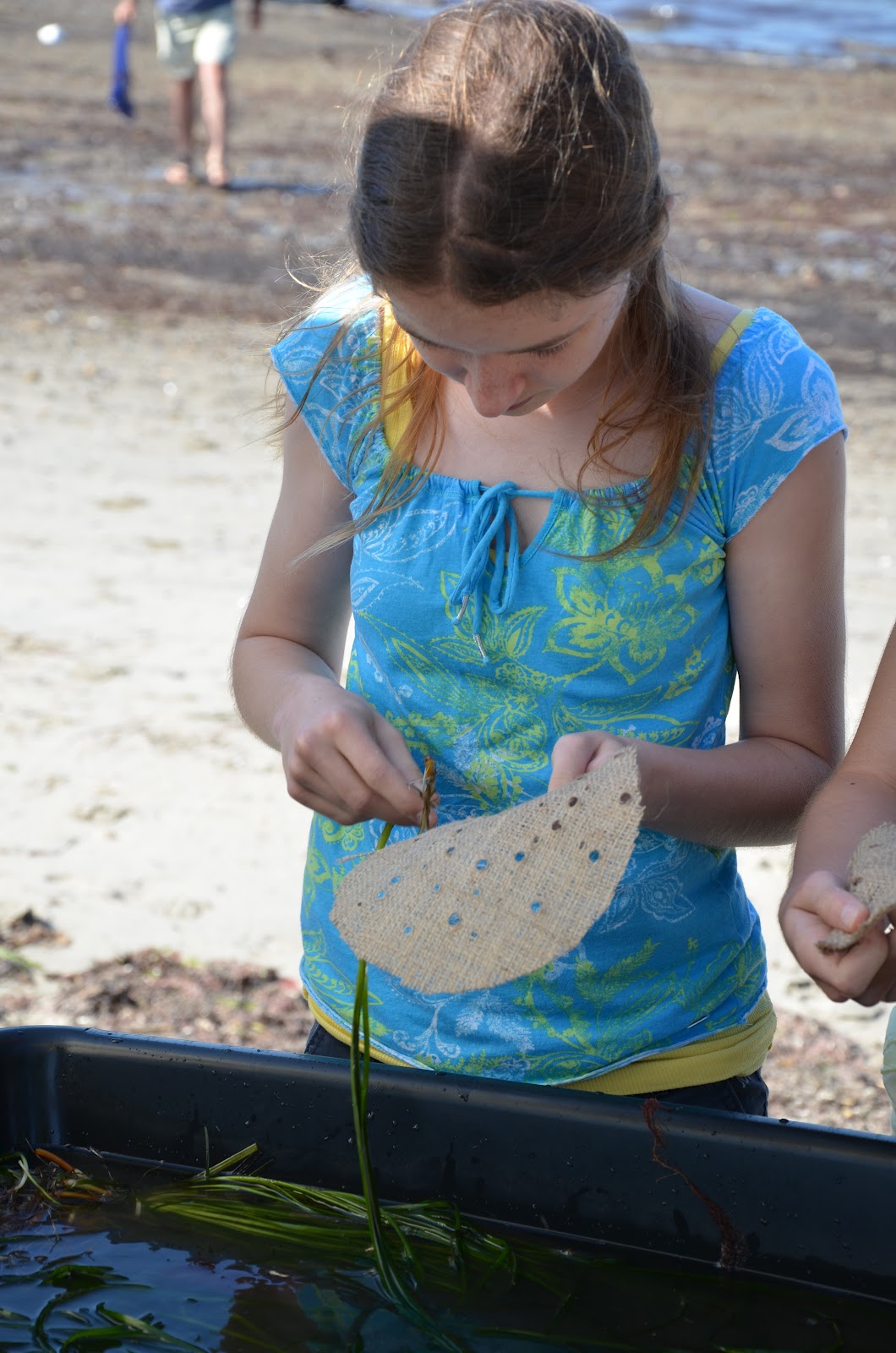
On Tuesday 6/19/12, twelve volunteers from the New England Aquarium's Live Blue Ambassadors group made the journey from Boston to Beverly on a sunny, breezy morning. The group arrived around 8am at Lynch Park to help prepare the work stations and begin weaving eelgrass into burlap discs or "tortillas".
Volunteers worked throughout the morning at a great pace, finishing enough discs to get the divers in the water around 11am for their first planting dive off of Woodbury Point. Plants were transferred from the beach to the dive boat via DMF biologist Devon Winkler in a small Lund motor boat.
DMF Divers Wes, Tay, Mark and Jill completed two 1+ hour dives to plant 260 discs (2,600 plants) in 5m x 5m checkerboard plots at pre-determined intervals along two transect lines. Dive conditions were excellent, with great visibility and low current, but enough flushing to keep suspended sediment from clouding the work area.
With the help of our beach-side volunteers on both 6/12 and 6/19, DMF planted over 6,500 eelgrass shoots in Salem Sound. We look forward to monitoring the sites in the coming weeks and months to evaluate success, as well as performing additional plantings. If the Fort Pickering and Woodbury Point plots are both successful, we can expect a total of at least 0.5 acre of new eelgrass habitat to be restored to Salem Sound.
Our special thanks to:
Lucy Indge, Lindsay Beene and the Live Blue Ambassadors from New England Aquarium (Amanda Bartlett, Sabrina Tirachen, Ashley Hamel, Bree-Anna Nicoletti, Rose Fantozzi, Alannah O’Brien, Grace O’Brien, Catie Blair, Clayton Mears, Lucy Fitzgerald)
Barbara Warren, Susan Yochelson and volunteers from Salem Sound Coastwatch (Lynn Atkinson, Dawn Paul, Marilyn McCrory, Susan Purser, Ewa Newman, Albert Levesque, Peter Phippen, Geoffrey Walker, Connor Hilfinger, Vanessa Zendejas)
DMF staff Matt Ayer, Elaine Brewer, Devon Winkler and Chris Wood
Beverly Department of Parks and Recreation
Salem's Winter Island Park staff
Lucy Indge, Lindsay Beene and the Live Blue Ambassadors from New England Aquarium (Amanda Bartlett, Sabrina Tirachen, Ashley Hamel, Bree-Anna Nicoletti, Rose Fantozzi, Alannah O’Brien, Grace O’Brien, Catie Blair, Clayton Mears, Lucy Fitzgerald)
Barbara Warren, Susan Yochelson and volunteers from Salem Sound Coastwatch (Lynn Atkinson, Dawn Paul, Marilyn McCrory, Susan Purser, Ewa Newman, Albert Levesque, Peter Phippen, Geoffrey Walker, Connor Hilfinger, Vanessa Zendejas)
DMF staff Matt Ayer, Elaine Brewer, Devon Winkler and Chris Wood
Beverly Department of Parks and Recreation
Salem's Winter Island Park staff
Wednesday, June 13, 2012
Restoration in Salem Sound: Volunteer Day 6/12/12
With the help of 12 shore-side volunteers from Salem Sound Coastwatch, DMF Eelgrass Project staff successfully planted 4,000 shoots of grass off the beach at Fort Pickering, Winter Island in Salem yesterday.
Volunteers learned about the project background, eelgrass biology and DMF's restoration goals during a training session at Beverly Public Library on Monday night.
On Tuesday 6/12/12, volunteers arrived at Waikiki Beach at Winter Island to get started around 8am. The work area consisted of a large tent shading three work tables, 5 totes filled with cool sea water and bundles of plants harvested on the previous day.
Kate Ostrikis was the beach-side coordinator, demonstrating proper tortilla-weaving techniques, performing quality control, and affixing completed discs to skewers to be sent to the dive team. Volunteers worked until noon to complete approximately 40 discs (each containing 10 plants) per person, reaching our goal of 4,000 plants for the day.
When enough discs were weaved for the first round of planting, DMF divers Wes, Tay, Mark and Jill suited up and laid out the site. Three 1+ hour dives were completed to plant over 400 discs in 5m x5m checkerboard plots at pre-determined intervals along two transect lines. Divers were met with moderate-to-good diving conditions, but realized quickly that fine, silty sediment is a challenge for this planting method since it requires digging up the sediment to plant and back-fill the discs. It's difficult, but doable - and still a fast method considering how many plants were put in the ground per hour (650 plants/buddy team/dive).
We look forward to our next volunteer day on Tuesday 6/19, when the Live Blue Ambassadors group from the N.E. Aquarium will assist us as we plant a site off Woodbury Point, Lynch Park, Beverly. More pics and info to come.
Volunteers learned about the project background, eelgrass biology and DMF's restoration goals during a training session at Beverly Public Library on Monday night.
On Tuesday 6/12/12, volunteers arrived at Waikiki Beach at Winter Island to get started around 8am. The work area consisted of a large tent shading three work tables, 5 totes filled with cool sea water and bundles of plants harvested on the previous day.
Kate Ostrikis was the beach-side coordinator, demonstrating proper tortilla-weaving techniques, performing quality control, and affixing completed discs to skewers to be sent to the dive team. Volunteers worked until noon to complete approximately 40 discs (each containing 10 plants) per person, reaching our goal of 4,000 plants for the day.
We look forward to our next volunteer day on Tuesday 6/19, when the Live Blue Ambassadors group from the N.E. Aquarium will assist us as we plant a site off Woodbury Point, Lynch Park, Beverly. More pics and info to come.
Friday, May 25, 2012
Drifting mats of red algae
Yesterday MarineFisheries biologists were diving in Salem Sound near Pride's Beach in Beverly when we encountered large mats of the reddish brown algae that I think is Heterosiphonia japonica. http://www.seaweed.ie/descriptions/Heterosiphonia_japonica.html. This is the first we have seen it here to this extent. In April at a site nearby we noted small amounts of it driftying through the grass bed, although it was piling up on the beach. So yesterday we were surprised to see such an accumulation (see pictures below). The change from April to May may be due to the progression of the season and more algae growth, or it could simply have been a different current and wind direction blowing the algae into the bed that day, or a combination of the two. Whatever the reason, this could definitely have a significant impact on the bed by blanketing shoots and shading them. It will be interesting to see if the algae is there when we return to the site in the next few weeks. We also have three transects that we monitor for SeagrassNet in this area and our next monitoring event is in July. This highlights the reason why we need long term monitoring like SeagrassNet sites. If there is an impact on the eelgrass bed we will hopefully be able to document it early.
Subscribe to:
Posts (Atom)