Welcome to SeagrassSoundings Blog

Welcome to SeagrassSoundings Blog


SeagrassSoundings focuses on the work that scientists and managers are doing to protect, preserve, study, restore and monitor seagrass in Massachusetts and throughout New England.


Showing posts with label Salem Sound. Show all posts

Wednesday, September 13, 2017

Eelgrass restoration and genetic experiment in Salem Sound 2017

✔ 1/2 acre of eelgrass planted 

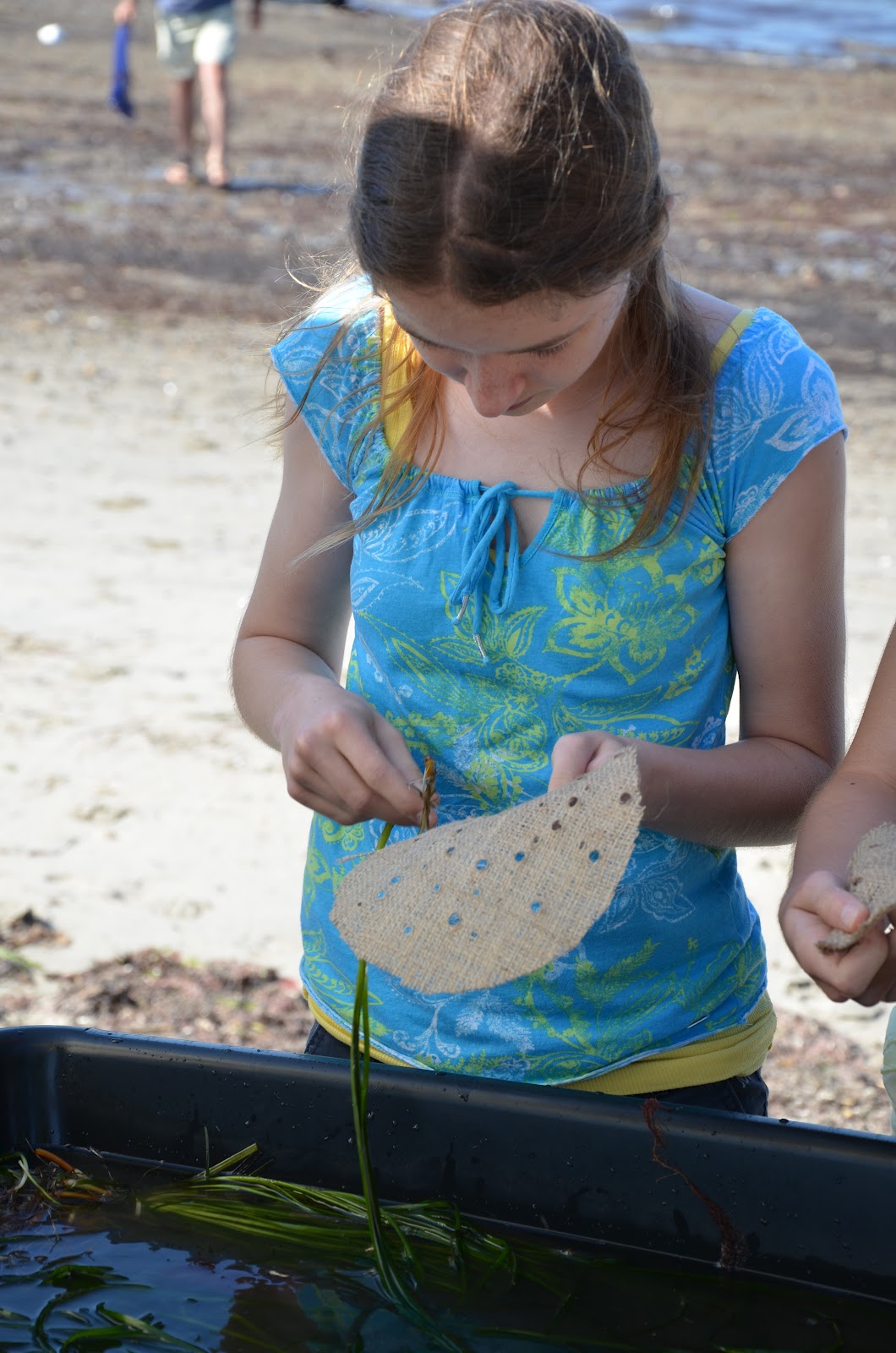
After great transplanting success in Boston Harbor and Salem Sound under the HUB3 mitigation project, MarineFisheries is at it again. In early April 2017, divers from MarineFisheries (DMF) and Northeastern University (NEU) began the spring planting of the first quarter-acre site, which included harvesting eelgrass from multiple donor sites, weaving the eelgrass into burlap discs using the method developed by Chris Pickerell, of Cornell Cooperative Extension, and planting the discs at Middle Ground in Salem Sound.
DMF and NEU divers aboard DMF's R/V Craven, ready to plant eelgrass in May 2017
                       
Eelgrass planted in Spring 2017
Eelgrass (Zostera marina) is an important marine flowering plant that provides habitat for many fish and invertebrates including commercially and recreationally harvested species such as winter flounder, bay scallop and American lobster. Widespread eelgrass declines in Massachusetts, including a documented 18% loss of eelgrass in Salem Sound between 1995 and 2012, have lead to concern and a call for increased protection and restoration efforts. The two quarter-acre sites were planted in a checker-board pattern that was designed to enhance the spread and expansion of the grass and provide immediate habitat structure and function.

After monitoring confirmed that the Spring quarter-acre restoration site had survived and the eelgrass looked healthy, Fall planting took place in late August and early September at an adjacent quarter-acre site on Middle Ground.  The Fall restoration process was conducted utilizing the same methods as the Spring planting for a seasonal comparison.  On September 7, the final plots were planted at Middle Ground successfully.  We will be back in October to monitor after one month, then back again in 6 months and one year.

Funding for this fisheries habitat restoration is from the Massachusetts In Lieu Fee Program (ILFP), developed by the Army Corps of Engineers and administered by the Massachusetts Department of Fish and Game (DFG).  The ILFP affords Corps permittees the option of paying a fee as mitigation for their project impacts to federally-regulated aquatic resources, in-lieu of conducting their own on-the-ground mitigation project.  As The Commonwealth’s program sponsor, DFG aggregates the ILFP payments for use on larger-scale mitigation projects with long-term monitoring.  The goal is to increase the likelihood of mitigation success by scaling up the restoration and monitoring effort.  Proposals for ILFP funding must meet prioritization criteria outlined in the ILFP instrument including targeting resources under threat, restoration near the same area where the impacts occurred, and compatibility with broader conservation and management initiatives.  DFG has collected over $1,000,000 in ILFP payments from 26 individual permitees since the program began in 2014 and is currently in the process of identifying and selecting other mitigation projects for a future round of funding.  More information about the ILFP and the prioritization criteria can be found online here (http://www.mass.gov/eea/agencies/dfg/about/in-lieu-fee-mitigation-program-for-massachusetts.html).

In addition to a habitat restoration, DMF is also testing the use of multiple donor sites to improve restoration success by increasing genetic diversity and resilience to disease stress. By testing the genetics of donor sites, we hope to greatly improve the results of future restoration efforts as well as continue to expand our understanding of what characteristics make an ideal donor site and a successful restoration.

Burlap Disc with eelgrass and pvc collar ready to be planted.  Disc is buried with sediment and PVC is removed
Planting along three 40 meter transects, MarineFisheries biologists and the scientists from Northeastern scooped the sand and rocks away, placed burlap disks woven with eelgrass plants into the scooped areas and then carefully buried them with a thin layer of sediment.
 Each disk contained eelgrass from five, three or one donor meadow.  Plants from each donor site and from the new restoration site will be tested for their genetic composition and for the relative success of the mono vs. poly-source transplants, measured as the shoot density, percent cover and plot aerial expansion.


Keep an eye on the blog for updates from our monitoring efforts as well as posts about other interesting eelgrass projects that MarineFisheries is working on!

- Tay, Jill, Kate and Alex


Monday, July 1, 2013

Spring recap

Jill Carr measuring canopy height at a Nahant reference bed.
Despite all the bad weather that we've had, it was a very busy and productive spring for the MarineFisheries HUB3 eelgrass restoration project.  Our work has shifted from Salem Sound to Boston Harbor, and the spring was spent planting and monitoring at six sites that were selected last fall.  The sites that were selected for restoration are Green Island, Great Brewster Island, Gallops Island, Long Island, Governors Island Flats, and Deer Island Flats.  All of our harvesting for the Boston Harbor restoration will take place in expansive natural eelgrass beds near Nahant.  We also began monitoring at three reference beds; two near Nahant and one east of Logan Airport.  As noted in a May post, during our initial assessment of the reference beds and harvest sites, it appeared that some of the natural beds had suffered some damage from winter storms that battered the area.  While we don’t have enough data to say for sure, the beds do seem to be rebounding as seedlings are growing and filling in some of the bare areas.    

Boston Harbor restoration, reference, and harvest sites.
The Boston Harbor sites are set up in a similar layout to our six plots per ¼ acre sites in Salem Sound.  The plots that were planted this spring will act as test plots and five additional plots will be added to the sites that are deemed successful based on the initial plots.  Our goal is to get at least 1 acre planted in Boston Harbor.  We are planning to use volunteers for large scale planting days again as last year’s volunteer days with Salem Sound Coastwatch and The New England Aquarium’s Live Blue Ambassadors program were a huge success.

Earlier in the spring, we looked at two of our restoration sites that were planted last year in Salem Sound.  Both the Woodbury Point site and the Middle Ground site survived the winter and appeared to be expanding.  A full monitoring event is planned for all of the Salem Sound sites in late July so that we can determine the actual one year success of those sites.

We are all keeping our fingers crossed for the weather to begin to improve.  We have a lot of work to do throughout the summer, so stay tuned for further updates.

Monday, May 6, 2013

Declining density and extent of eelgrass at Salem Sound and Nahant could be due to storm damage


Hi! Back in the water again after a long winter in the office...


Nahant

So far we have been to the Nahant meadow twice this spring.  The first time in April we came to retrieve a hobo temp/light monitor and harvest for plantings in Boston Harbor outer islands. Notes from August 2012 at that site indicate that plants were tall and lush, 75% cover and approximately 80shts/m2 with many reproductive shoots.  The meadow was continuous with few open patches.  But in April, we observed a low density patchy bed with large eroded areas and other areas of deep sand waves.  Our screw anchor, installed back at the end of August 2012, was buried up to the eye. 

We were back at the Nahant eelgrass meadow last week looking for a site to establish a monitoring station.  We ran a drop camera along several transects spaced throughout the DEP mapped area.  We were surprised and disappointed to find a large portion of the area mapped by DEP in 2006 is now gone and the remaining grass is mostly patchy, similar to what we saw in April.  The southeast lobe of the bed persists, but has contracted from it's 2006 extent.  Check out the rough map below digitized from our field notes, showing the remaining meadow, and an area of patchy grass and other sections of the bed that are now only sand waves.


We plan to return with divers for a closer look to help determine what might have occurred.  From the camera view it appeared that sand waves had swept over the bed, possibly burying the grass.  This meadow has long been a lush dense meadow and one of the few remaining north of Boston of this size (in MA).  Many groups have used this bed as a reference bed and donor bed for eelgrass projects in Boston.  The green dots on the map above show the locations where we are investigating possible establishment of a new SeagrassNet, long term monitoring station.


Salem Sound

At our SeagrassNet site in Salem Sound (Misery Island, Beverly) we also found low density and evidence of erosion.  It looked like much of the sand had been washed away leaving a hard-packed clay.  There is still grass clinging to the clay, so hopefully as the season progresses it will fill back in.  I think we are seeing the effects of a late winter with several storms, including NEMO in February 2013.


Sand eroded away leaving hard-packed clay over much of the shallow side (transect A) of the meadow


SeagrassNet quadrat showing low density eelgrass and eroded areas of clay


erosion around a small eelgrass clump near transect A

Taking a biomass sample on Transect B


Friday, February 1, 2013

January Field Work

Frozen Lanes Cove, Gloucester, MA.

Field work in January is far from routine in New England.  With temperatures ranging from 1°F on January 24th to 62°F on January 31st and winds gusting most days to 25 knots, it’s tough to schedule time on the water.  It always seems that the coldest days are the calmest and the warmer days are riddled with fog and wind.  The extreme temperature swings, snowstorms, downpours, and 60 knot gusts make January an ideal time   to snuggle up to a cup of tea   and start planning for spring fieldwork. 

Eelgrass in January.
But, on January 16th, DMF divers managed to sneak in one day in the field to complete a portion of the quarterly SeagrassNet monitoring.  The day started out snowing heavily with zero visibility.  The forecast called for the snow to end early and there was no wind, making for calm seas for the short steam from Gloucester Harbor to Salem Sound.  Upon arrival to the SeagrassNet site, the snow began to let up as forecasted and the divers were ready to go.  The first team in the water managed to complete an entire transect.  The 40°F water was a welcome change from the 30°F air even though that still makes for numb fingers that don’t function well with a pencil in hand. 
Ross is excited for our steam back to the dock 
in the heated wheelhouse of the R/V Alosa.

The eelgrass at the SeagrassNet site looked healthy.  As is typical in the winter, the density had decreased and shoots were small and brilliant green.  With an average of 111 shoots / m2, a mean percent cover of approximately 20%, and an average shoot height of 37 cm, the meadow is seasonally at a lower density compared to the 75% - 90% cover typically found in July. 

The next quarterly monitoring in April will kick off a busy spring and summer.  In the meantime, the DMF eelgrass team will be hard at work the rest of the winter planning for another season of eelgrass restoration, monitoring, and mapping.

Tuesday, June 26, 2012

Restoration in Salem Sound: Another Successful Volunteer Day 6/19/12

On Tuesday 6/19/12, twelve volunteers from the New England Aquarium's Live Blue Ambassadors group made the journey from Boston to Beverly on a sunny, breezy morning. The group arrived around 8am at Lynch Park to help prepare the work stations and begin weaving eelgrass into burlap discs or "tortillas".
 

Volunteers worked throughout the morning at a great pace, finishing enough discs to get the divers in the water around 11am for their first planting dive off of Woodbury Point. Plants were transferred from the beach to the dive boat via DMF biologist Devon Winkler in a small Lund motor boat.


DMF Divers Wes, Tay, Mark and Jill completed two 1+ hour dives to plant 260 discs (2,600 plants) in 5m x 5m checkerboard plots at pre-determined intervals along two transect lines. Dive conditions were excellent, with great visibility and low current, but enough flushing to keep suspended sediment from clouding the work area.


With the help of our beach-side volunteers on both 6/12 and 6/19, DMF planted over 6,500 eelgrass shoots in Salem Sound. We look forward to monitoring the sites in the coming weeks and months to evaluate success, as well as performing additional plantings. If the Fort Pickering and Woodbury Point plots are both successful, we can expect a total of at least 0.5 acre of new eelgrass habitat to be restored to Salem Sound.


Our special thanks to:

Lucy Indge, Lindsay Beene and the Live Blue Ambassadors from New England Aquarium (Amanda Bartlett, Sabrina Tirachen, Ashley Hamel, Bree-Anna Nicoletti, Rose Fantozzi, Alannah O’Brien, Grace O’Brien, Catie Blair, Clayton Mears, Lucy Fitzgerald)

Barbara Warren, Susan Yochelson and volunteers from Salem Sound Coastwatch (Lynn Atkinson, Dawn Paul, Marilyn McCrory, Susan Purser, Ewa Newman, Albert Levesque, Peter Phippen, Geoffrey Walker, Connor Hilfinger, Vanessa Zendejas)

DMF staff Matt Ayer, Elaine Brewer, Devon Winkler and Chris Wood

Beverly Department of Parks and Recreation

Salem's Winter Island Park staff